Welcome back to Books With Cause. Let’s dive straight into my latest review.
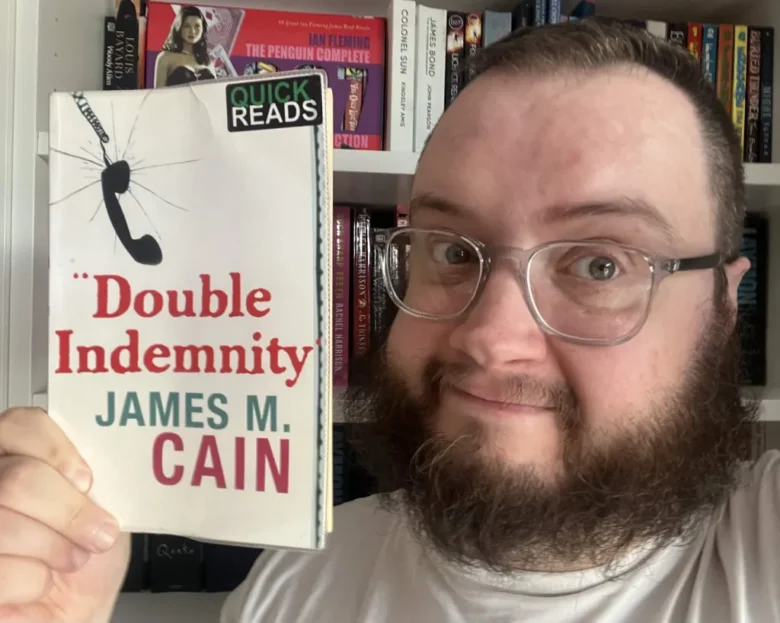
A few months ago, I took my brother to see the play version of Double Indemnity as part of his Christmas present. It was touring all over the country at the time, and its major selling point was that they had Mischa Barton – from The OC fame – starring in it. This turned out to be a bit of a ploy, as Barton doesn’t play the lead role and she wasn’t in the play as much as some people might’ve been expected. That included me, as I hadn’t read the book at that time. That came a little later.
Double Indemnity is a novella written as a tell-all confession from the POV of insurance salesman Walter Huff. It starts off like any other day for Huff, when he calls in on a Mr Nirdlinger, whose car insurance is due for renewal. Mr Nirdlinger isn’t in, so instead Huff ends up speaking to Mrs Nirdlinger – Phyllis. Phyllis reveals that her husband is thinking of going elsewhere for his auto insurance, but implies that she can convince him to go with Huff. She also floats the idea of buying an accident insurance policy without her husband’s knowledge.
Huff realises that Phyllis is planning to murder her husband and claim the insurance payout. While he knows it’s wrong, he also finds himself falling for Phyllis. Not only does he offer to help her, but he also takes the lead in planning how they murder Mr Nirdlinger. As an expert in his field, Huff knows that insurance companies pay out double indemnity on railway accidents. All Huff has to do is trick Mr Nirdlinger into signing the insurance policy. Then he has to make Nirdlinger’s death look like he fell from a moving train. If they can do all that, then Huff and Phyllis stand to make $50,000, which they intend to split down the middle. But can they pull it off? And can they trust each other?
I understand that Double Indemnity has been adapted for the big screen twice, and both versions differ quite a bit from the book. But I will say that the play I saw was almost identical to this book and serves well as a companion piece. For me, reading this book was an immersive experience as I could hear the voices of the characters in the play. The visuals and atmosphere were similar in my imagination too.
The novella is 136 pages. The library advertises it as a Quick Read, which it certainly was in my experience. I read the whole thing in two sittings.
It’s easy to see why this book is so highly regarded and why Cain is considered an originator of the hard-boiled crime genre. I highly enjoyed it – partly because I’ve seen the play, and also because I have a fondness for this era of history. I was brought up on old Bond movies (and even they’re newer than this), so I look back on a time where things were simpler, and there was less urgency. This book is a product of its time, and it’s the kind of book that couldn’t be written now. Primarily because of the internet, people buy their car insurance over the internet. Walter Huff’s job wouldn’t exist in the same way it did in this book. The whole plot of the book wouldn’t get past the first page because the characters of Huff and Phyllis Nirdlinger wouldn’t ever meet today.
I’m not sitting here suggesting we should undo the past and go back to how things were. No, I think the horse has bolted way too far from the stable for that one. But for the nostalgic among us, I think books like this provide vital insight into the way things were. And they’re written to be enjoyed.
My Goodreads rating:★★★★☆(4 stars)