Welcome back to Books With Cause. Let’s dive straight into my latest review.
Remember, remember the fifth of November, the gunpowder treason and plot. I know of no reason why the gunpowder treason should ever be forgot.
Now, sit tight, because this one might be a bit of a convoluted one, but I’ll do my best to keep it as concise as possible. It was Bonfire Night last week (or Guy Fawkes Night, depending on what you might call it), and I had intended to have this review ready for the 5th of November, but The Talisman series took me longer than expected. I quite like it when my reading coincides with the calendar, but it’s not always possible.
That said, the whole Guy Fawkes affair is something I find rather baffling. For as long as I live, I don’t think I’ll ever forget learning about Guy Fawkes in school. I was in Year 3, and my teacher prefaced the whole thing by saying: “This is an example of a story where the baddies win”. It wasn’t hard for me to picture King James I as the villain and that Fawkes and co would have their reasons for wanting him dead. I’ve been a Republican for as long as I can remember – before I even knew there was a term for such a thing. And by that, I mean that I believe the monarchy should be abolished. I don’t mean Republican in the American political meaning of the word. Rest assured, if I were an American citizen, I would likely vote Democrat. Anyway, all that aside, it baffled me why we observe Bonfire/Fireworks night to “celebrate” the failed gunpowder plot. As the old saying goes: “Guy Fawkes was the last person to enter Parliament with honest intentions”.
I remember seeing the film V for Vendetta on DVD when it first came out, and back then I had no idea it was adapted from a comic. I just remember thinking it was really cool, especially the certain visuals in the final scene. I can’t remember how I discovered that it was adapted from a comic, or the fact that the comic was written by Alan Moore, but somewhere along the line I became a fan of Moore. A few years ago, he did a writing course for BBC Maestro, which I bought. Maybe it’s the closest I’ll get to actually having him as my writing tutor, but I remember being hooked on those videos and devouring his every word. He comes across like a kooky old warlock, and I came away from every video inspired to tackle my own writing.
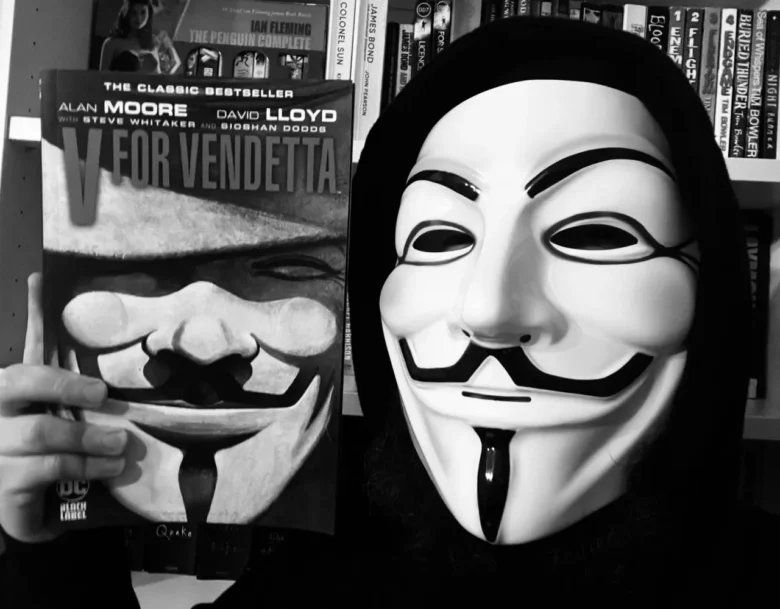
Reading more of Moore’s work became inevitable, and I bought myself a copy of the complete V for Vendetta. It was the 20th anniversary of the film recently, and Cineworld showed it in the buildup to Bonfire Night, so I decided it was time to align my reading of the comic with seeing the adaptation on the silver screen. Now, there are similarities and differences between the comic and the film. Moore is on record as hating the film and declined his credit and payment for it. From here on out, my review is solely about the book.
Published between 1982 and 1989, V for Vendetta imagines a dystopian, post-apocalyptic version of the United Kingdom in 1997. We meet a teenager named Evey Hammond who is out beyond curfew on November 5th. She is captured by a group of secret state police officers known as the Fingermen. The Fingermen plan to rape and kill her when Evey is saved by a man dressed as Guy Fawkes. The man introduces himself only by the codename V. After rescuing her, V takes Evey to the rooftop of a nearby building where they watch the remote detonation of the Houses of Parliament. V immediately becomes an enemy of the Government in this dystopian story, and Evey becomes his unlikely (and sometimes unwilling) accomplice.
I enjoyed this a lot. It’s been a while since I read a comic, so that in itself was refreshing. Because of the differences between the book and the film, there were times where I thought I knew what was happening next and there were times that I was surprised. I love the character of V and especially that we know little about him. We’re given some of his backstory and why he’s out for revenge, but we never learn his real name or see his real face. I’m pleased that Moore did that, because I think the story would lose some of its power if his identity were revealed. This is a great dystopian and anti-establishment read.
The copy that I read includes forewords by both David Lloyd and Alan Moore, as well as an article by Moore about how the idea(s) for V for Vendetta came about. I found the article fascinating because I love seeing behind the scenes of how books come about, and Moore is frank and honest in his account. Their imagined version of the future hinged on the theory that the Conservatives were guaranteed to lose the 1983 General Election. It seems that Moore learnt to stick to writing rather than making prophecies.
My Goodreads Rating: ★★★★☆ (4 stars)