Welcome back to Books With Cause. Let’s dive straight into my latest review.
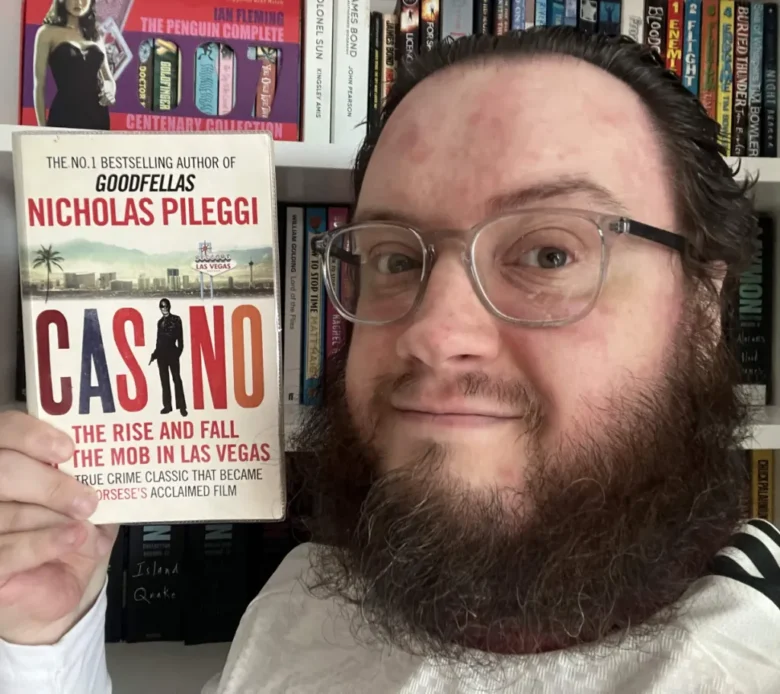
At the end of summer, Cineworld’s Martin Scorsese season finished off with Casino. Having seen the majority of the ones that Cineworld screened, I decided I wanted to see this one too, especially as I hadn’t seen it before. I must admit that there’s a bit of underhandedness to this story. I was away for the week with my girlfriend. We were having a little staycation, and I told her I’d booked us in to see this film. I know that she doesn’t like long films. Two hours is generally her limit. Anything more than that – in her opinion – is too long. And Casino is three hours. But she didn’t ask me how long the film was until the film started. For the record, I would have told her whenever she asked me; it just so happened that she didn’t bother asking until we were sat down and the film had started.
“How long is this?” she asked me.
“About three hours,” I said.
“Are you joking?”
“No.” Why would I?
“If you’re joking, just tell me now,” she said.
“I’m not joking,” I said. But she still didn’t believe me.
So she pulled her phone out and Googled the film. “For fuck’s sake,” she said once she saw the runtime.
Needless to say, she didn’t like the film. It was too violent for her tastes (as well as being too long). But I have to give her due; she sat and watched the whole thing.
I haven’t had the heart to tell her I’ve been reading the book recently.
From here on out, I’m strictly talking about the book. While the plot is identical in the book and the film, the names of the characters in the film are fictional. Casino tells the true story of Frank “Lefty” Rosenthal, who worked for a Mafia crime family known as The Chicago Outfit. During the 1970s and early 80s, the Chicago Outfit controlled most of the casinos in Las Vegas, and they put Rosenthal in charge of running the operation at the Stardust Casino. Due to his criminal history, Rosenthal was ineligible for a gaming license, which meant that he managed the casino illegally. Meanwhile, Rosenthal’s best friend, Anthony Spilotro, also worked for the Chicago Outfit and was in charge of protection. Maybe they got too big and too noisy too quickly. It wasn’t long before the FBI came sniffing around. Perhaps aptly for Vegas, it could be argued the operation was built on a house of cards, and maybe it was only a matter of time before all the cards started to fall.
I was somewhat excited about reading this book, but there’s no other way of saying that it came a little short of my expectations. Most of the chapters consisted of interviews with people directly involved in the story – especially Rosenthal – but as a result, it often felt like reading a documentary transcript. I feel like I’d enjoy watching a documentary with these talking heads, but reading it just didn’t grip me. For me, it helped to picture certain moments in the book because I’d seen the film. I think I might have enjoyed this book less without the film as a reference point.
I feel awful criticising a book, especially without my criticism being constructive. I can’t offer a way in which I think I’d have improved the book or written it any differently; I can only say that I always felt at a distance from the book where other stories can engulf me completely. I understand that Pileggi also wrote Wiseguy, which was adapted into Goodfellas. Maybe I’ll give that a read one day and have a better experience.
My Goodreads Rating: ★★★☆☆ (3 stars)
Further Reading
If you’re a fan of Martin Scorsese’s films, you might also be interested in my reviews of the books that inspired Shutter Island and The Wolf of Wall Street.