It feels like a lifetime ago that No Time To Die was released, in which we saw Daniel Craig play James Bond for the final time. There have been a lot of changes since then, with the Broccolis bowing out and Amazon taking full creative control. It was recently announced that Denis Villeneuve would be directing the next instalment, with Steven Knight penning the script. But we’re no further to knowing who the next lucky actor will be to play 007.
I have been a die-hard Bond fan for nearly all my life. I think I was eight years old when I first saw Goldfinger on television. I was hooked immediately. From that point onwards, I collected the entire film series, first on VHS and then on DVD. I think I’ve played all the video games. I own encyclopaedias and fact files. I know way too many trivial facts about Bond, and my brain is riddled with film quotes. Despite all of that, I didn’t read a Bond novel until I was 18. One day, my parents came home with a box set of the original Fleming novels. Having read all of them a couple of times, I decided it was time to tackle the lengthy list of continuation novels penned by a range of other writers.
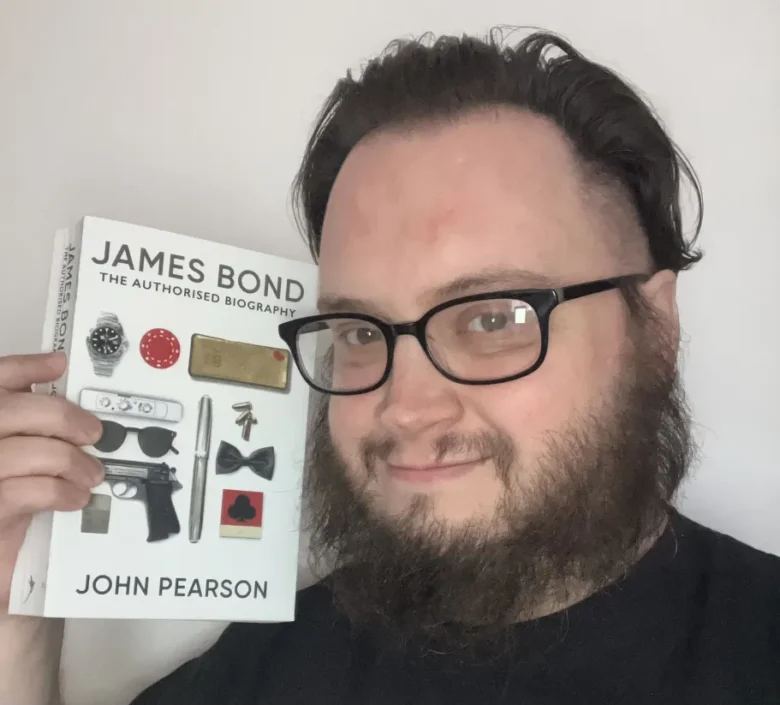
James Bond: The Authorised Biography is the second ever Bond continuation novel after Colonel Sun by Kingsley Amis. This is a book that’s a little tricky to get your head around at first. For a start, you might be wondering how and why a fictional character has an authorised biography. For context: Pearson has written numerous real-life biographies of the likes of the Kray Twins and Ian Fleming – the latter of which he was good friends with. Secondly, it is common knowledge that Fleming based a lot of the Bond character on himself. It was while writing the Fleming biography that Pearson got the idea for this book.
This is an example of a novel that reads almost like non-fiction. Pearson himself is a character within the story who is tasked with writing the biography of ‘the real James Bond’. Pearson meets Bond, now in his fifties and on leave in Bermuda while he awaits a new assignment from MI6. Although reluctant at first, Bond acquiesces to tell his life story over fine meals, many strong drinks, and the occasional cigarette.
If you’re familiar with the backstory of Bond within the novels or feature films, then much of this book will feel familiar, although there are some minor differences. Bond tells Pearson about his childhood, which includes losing both his parents at a young age and being kicked out of Eton. Within this story, it’s claimed that Bond met Fleming and the two of them became friends. Of course, Fleming had a background working in Naval Intelligence during the Second World War; before he started work as a journalist, which would lead to him writing the Bond novels.
Bond tells Pearson that Fleming was close to M, and it was he who convinced M to give Bond a chance in the Secret Service. Bond is assigned the codename 007, and it could be said that the rest was history. Except not quite. The final piece of the jigsaw is that within this world, Fleming writes the adventures of Bond into the format of the novels that we’ve come to know around the world.
As he becomes more comfortable talking to Pearson, Bond tells him about each of his adventures to date in order. He takes us through Casino Royale and Live and Let Die and notes there are some differences between ‘what really happened’ and the way things are depicted in the novel version. ‘Fleming exaggerated that part,’ Bond tells Pearson.
The purpose of releasing the Bond novels was to try and convince the Russians that Bond was a fictional character – according to Bond in this book. He says that the events of Moonraker were made up completely to make the notion of Bond seem ridiculous as a real-life person. Of course, if you’ve read the novel, you know that Bond doesn’t go into space, unlike the Roger Moore adaptation, which is only loosely based on the source material.
While I’ve done my best to summarise the book, it is difficult to do so. I think that comes across here. Mostly because we all know that James Bond is a fictional character. The novels and the films exist in a world that’s slightly different to our own. Then this book seems to take place somewhere between the two different worlds. This Bond seems to straddle the two worlds, talking about the real-life Ian Fleming, while also talking about how the novels were changed from what really happened. There is also a brief mention of the films where Bond talks about how strange it was so see Sean Connery play him. (At the time this book was published, Roger Moore had only just inherited the role, so there are no references to Lazenby onwards).
Despite the difficulty in initially getting my head around it, this is a book that I thoroughly enjoyed. I was engrossed throughout and almost forgot that I was reading fiction. If it’s possible to convince anybody that Bond was a real person, then Pearson is the one who can do it. And it’s books like these that help us scratch the itch while we endlessly wait for the next Bond adventure on the silver screen.
My Goodreads rating: ★★★★☆ (4 stars)
Buy the Book:
These are affiliate links, which means I may earn a small commission if you buy through them, at no extra cost to you.