Welcome back to Books With Cause. Let’s dive straight into my latest review.
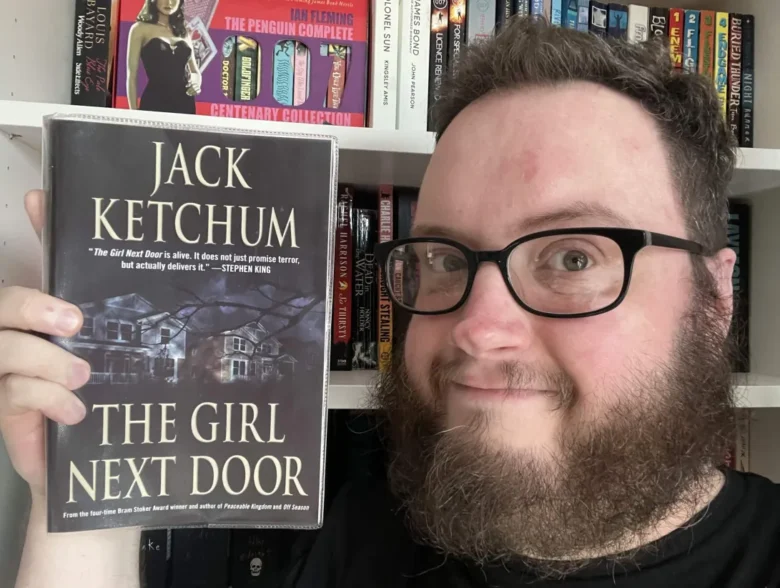
Jack Ketchum is an author I’ve been meaning to read for a long time. He is one of many authors that I’ve noticed Stephen King recommend on many occasions. Of course, when someone like Stephen King recommends another author, the rest of us have a duty to sit up and take notice. My own personal dream is opening Twitter one day to see a post from Stephen King: “Just checked out the latest Daniel Cause book. It gave me the chills, and I devoured it in one sitting.” That’s just me manifesting.
I can’t remember the exact details of how this Jack Ketchum book came to my knowledge. But somehow I had become aware of the Sylvia Likens case from the mid-60s. Somehow or another, I had then heard that Jack Ketchum had written a novel based on that case. And here we are.
The Girl Next Door was published in 1989. It has a framed narrative that also begins in that time as well. The narrator is David, a middle-aged man, twice divorced. He looks back on his teenage years growing up in the 1950s. In particular, he thinks about a summer break from school when he was friends with three brothers, and he’d spend a lot of time at their house. Their mother, Ruth, was very laid back and allowed virtually every child in the neighbourhood to hang out in her home and do whatever they wanted – mostly drinking and smoking – without any consequence at all.
Ruth’s nieces – Meg and Susan – come to live with her after their parents die unexpectedly. David develops feelings for Meg, which leads to him finding excuses to visit Ruth’s house more so he can see more of Meg.
Meg is the titular Girl Next Door in this story, and she also marks the turning point in this story. Very quickly, we learn that Ruth does not like Meg, although we don’t ever know why. That’s something we’re left to speculate on, although there are theories within the real-life case this novel is based on. Ruth always takes the side of her own sons over Meg and Susan. This really kicks off when Meg hits Ruth’s son, Ralph, after he tries to harass her. Ruth beats Susan, in front of Meg, as punishment. When Meg tries to report this to a police officer, not only is she not believed, but she is then tied up and kept prisoner in the bomb shelter.
From there on out, the abuse becomes increasingly horrific. As if it wasn’t bad enough coming from Ruth alone, she encourages her own sons and the many neighbourhood children to join in. This is a book that doesn’t pull many punches. It’s not an easy read, and it’s not for the fainthearted.
That said, there is an advantage to this being told in the form of a contemporary adult recounting a story from their childhood. There is a moment where David tells the reader that he will not tell them a certain part of the story. He just can’t bring himself to do it. From this, we get the impression that David is haunted by the experience, and it has stuck with him for some thirty years plus. We also get a feeling of regret on his part. Yet, as the reader, we are protected from certain horrors.
This edition of the book also includes two short stories along with an afterword where Ketchum tells the reader where he got the idea from. He mentions a book called Bloodletters and Badmen, written by Jay Robert Nash, which covers the Sylvia Likens case. He was inspired to write the story after seeing a photo of Sylvia’s killer in that book. I’ll be trying to get my hands on a copy. If I do, you know you can find my review of the book right here. Watch this space.
The version of the book I read also contained an interview with Ketchum along with the two screenwriters who adapted the novel into a movie that was released in 2007. I haven’t seen it yet, but I’m curious to give it a look and see how it compares.
My Goodreads Rating: ★★★★☆ (4 stars)