When I was about seven or eight years old, I remember staying the night at my best friend’s house. It was just something we did every so often. We went into the living room to say goodnight to his parents and found them watching a film. I instantly presumed it was an old film because it was in black and white. I don’t remember much about it – we weren’t in the room for long – but I seem to remember several children on the screen, all looking like Hitler’s dream with bright blonde hair. The sight of those children scared the shit out of me. But I think horror films always look even scarier in black and white. We asked them what they were watching, and they said Village of the Damned or Children of the Damned. I can’t remember which.
A year or so later, I saw the Village of the Damned parodied in an episode of The Simpsons called “Wild Barts Can’t Be Broken”. Let’s be honest, anything not parodied by The Simpsons, at this point, isn’t worth parodying.
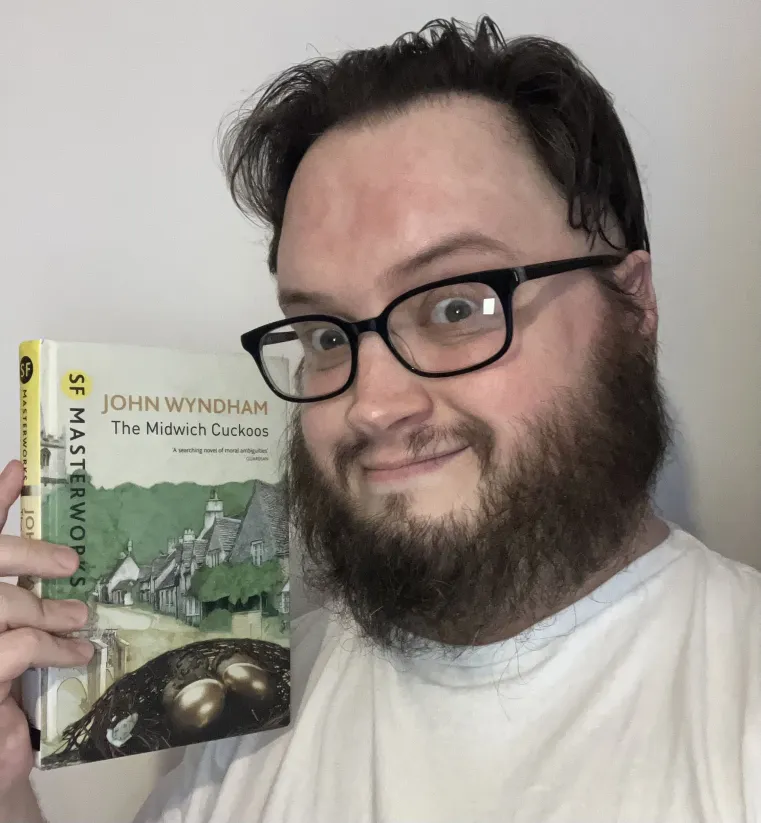
It wasn’t until many years later that I learnt that Village of the Damned was actually based on a book called The Midwich Cuckoos. At that point, it joined my mental To Be Read list and sat there for a good chunk of time. In amongst that time, there was also a television adaptation, this one using the same title as the novel, and starring Keeley Hawes alongside Max Beesley. At the time of writing this review, I still haven’t seen any of the adaptations.
First published in 1957, this novel is set in the fictional village of Midwich in the equally fictitious county of Winshire. Isn’t it funny how even the names create an image in our minds of what the place might be like? Maybe it’s that Winshire is very similar-sounding to Wiltshire. At the start of the novel, something strange is happening in the titular village. What can only be described as an invisible dome surrounds the place. Nobody can get in, and nobody can get out.
Just as quickly and inexplicably as it began, the effect disappears, and the residents of Midwich have no recollection of the time they’ve lost. Nothing seems to be wrong with them, so they carry on as if nothing happened. It’s only a few months later when every woman of childbearing age finds themselves pregnant. This creates numerous problems, as many of them have not had intercourse, and some of them are unmarried or their husbands were away.
The women give birth to children who all look similar to each other but bear no resemblance to their so-called parents. A total of thirty-one boys and thirty girls. They all have blonde hair, golden eyes, and pale silvery skin. The children also seem to develop at a rapid rate. By the time they reach the age of nine, they look like they should be sixteen. They’re all super smart and seem to share hive minds. If one of the boys knows something, all of the boys know it. Ditto with the girls. It doesn’t take a genius to figure out these children aren’t human. More than that, they’re dangerous. And they might just be unstoppable.
Maybe it’s not such a good idea to read a book after such a long build-up. While I love the concept and the overall idea, I didn’t find myself enjoying this book anywhere near as much as I’d hoped. The narrator of the story is one Richard Gayford, and he’s not even the protagonist. He’s a rather dull observer who summarises events after they’ve happened. To me, that really took the sting out of the story. A story that felt slow at the start but rushed at the end.
My Goodreads rating: ★★★☆☆ (3 stars)
Buy the Book:
These are affiliate links, which means I may earn a small commission if you buy through them, at no extra cost to you.